Can the Elephants Foot Happen Again Nuclear Meltdown 2017
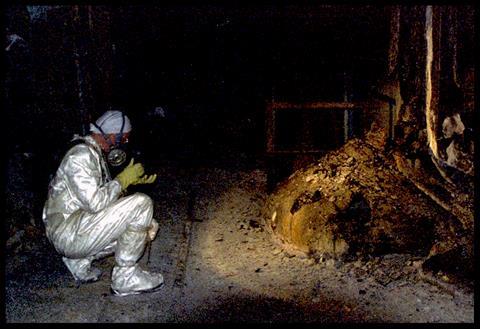
A new class of fabric has been created in the lab that mimics the radioactive, lava-similar waste created during nuclear meltdowns like those of Chernobyl and Fukushima. The simulant materials offering a much safer way of studying radioactive molten waste such every bit the infamous 'elephant's foot' at Chernobyl equally they are just slightly radioactive.
When reactor iv at the Chernobyl nuclear power plant suffered a catastrophic meltdown on 26 Apr 1986, the uranium core reached temperatures in backlog of 1600˚C. The vessel was then hot that that the zirconium cladding separating the fuel from the coolant fluid began to melt and combine with the uranium, steel, physical and sand present to form a radioactive, glass-like lava. Over fourth dimension, the lava melted through the base of the reactor vessel and several floors of the building before eventually coming to residuum in the basement where it cooled and solidified.
Information technology wasn't until December 1986 that members of the clean-upwardly crew discovered an off-shoot of the radioactive mass that has subsequently come to exist called the elephant'south human foot. Despite being only a pocket-size function of the roughly 100 tons of lava created during the meltdown, the elephant'south pes has become symbolic of the horrifying legacy of Chernobyl, largely due to its intense radioactivity. The mass was then radioactive when information technology starting time formed that if you had stood beside information technology, it would have killed you lot in effectually 300 seconds.
The elephant's foot'south radioactive decay, and that of other lava-like fuel-containing materials (LFCMs) at Chernobyl, has declined significantly since 1986, just it is still dangerous to approach it. Alongside concerns about groundwater contagion, one area of interest relates to corrosion damage caused past water condensation that has collected inside Chernobyl's sarcophagus. The water has caused new, uranium-containing phases to build upwardly on the surface of the material and, when the humidity in the sarcophagus drops below 85%, a significant amount of radioactive grit forms. It's estimated that the LFCMs at Chernobyl are releasing upwardly to 10kg of dust each twelvemonth.
Studying real LFCMs is very challenging, withal. Past enquiry has involved chipping off small quantities of material and handling them using protective equipment, merely such studies have been limited by the risks posed by the material.
Now, a squad from the University of Sheffield has used depleted uranium to develop depression-action materials that accurately mimic the microstructure and mineralogy of existent-LFCMs. To practice and so, they mixed precise amounts of reagents containing elements known to be nowadays in real LFCMs and heated them under a reducing temper at 1500˚C for four hours, then at 720˚C for a farther three days. The result was pocket-size batches of materials that exhibit the same uranium, zirconium and trace metal phases as LFCMs recovered from Chernobyl.
The researchers as well conducted the beginning successful synthesis of chernobylite, a high uranium–zircon silicate, via crystallisation from a glass melt. While chernobylite has previously been synthesised using heat handling of U–Zi–Si–O gels, it's possible that the new approach is closer to what actually happened at Chernobyl and and so may offering clearer insight into phenomena such as the elephant's foot.
'The paper represents a fine investigation of lava-like fuel containing materials, which were formed at some stages of cadre meltdown at Chernobyl and, presumably, at Fukushima,' says Andrei Shiryaev, a researcher from the Frumkin Institute of Physical Chemistry and Electrochemistry in Russian federation, who has previously investigated LFCMs at Chernobyl. 'It is an in-depth study giving interesting insights into formation of LFCMs. Indeed, some of the findings are really novel and surpass previous experiments.'
The team hopes that their LFCMs mimics can be used to perform analysis that is normally impossible so that we can better understand these materials – information vital for on-going attempts to decontaminate sites similar Chernobyl and Fukushima. This work may as well hateful fewer costly and highly chancy experiments are needed at large-calibration LFCM-testing facilities like Vulcano in France. With a smaller-scale alternative available, it may exist possible to reserve these facilities for only the most important research.
However, while these simulant LFCMs appear to be very like to real materials at Chernobyl, the team has warned that they are not a perfect match. In particular, they noted that their materials were synthesised using zirconium dioxide as a precursor, rather than the zirconium alloy cladding used at nuclear power plants.
'Of course, studies of simulant materials are important since they are way easier and let lots of experiments,' Shiryaev says. 'Notwithstanding, ane should be realistic about the meaning of studies of only the simulants. The difference is similar to that between doing real sport and playing videogames.'
Source: https://www.chemistryworld.com/news/chernobyls-intensely-radioactive-elephants-foot-lava-recreated-in-the-lab/4011170.article
0 Response to "Can the Elephants Foot Happen Again Nuclear Meltdown 2017"
Post a Comment